Prehistoric Policies
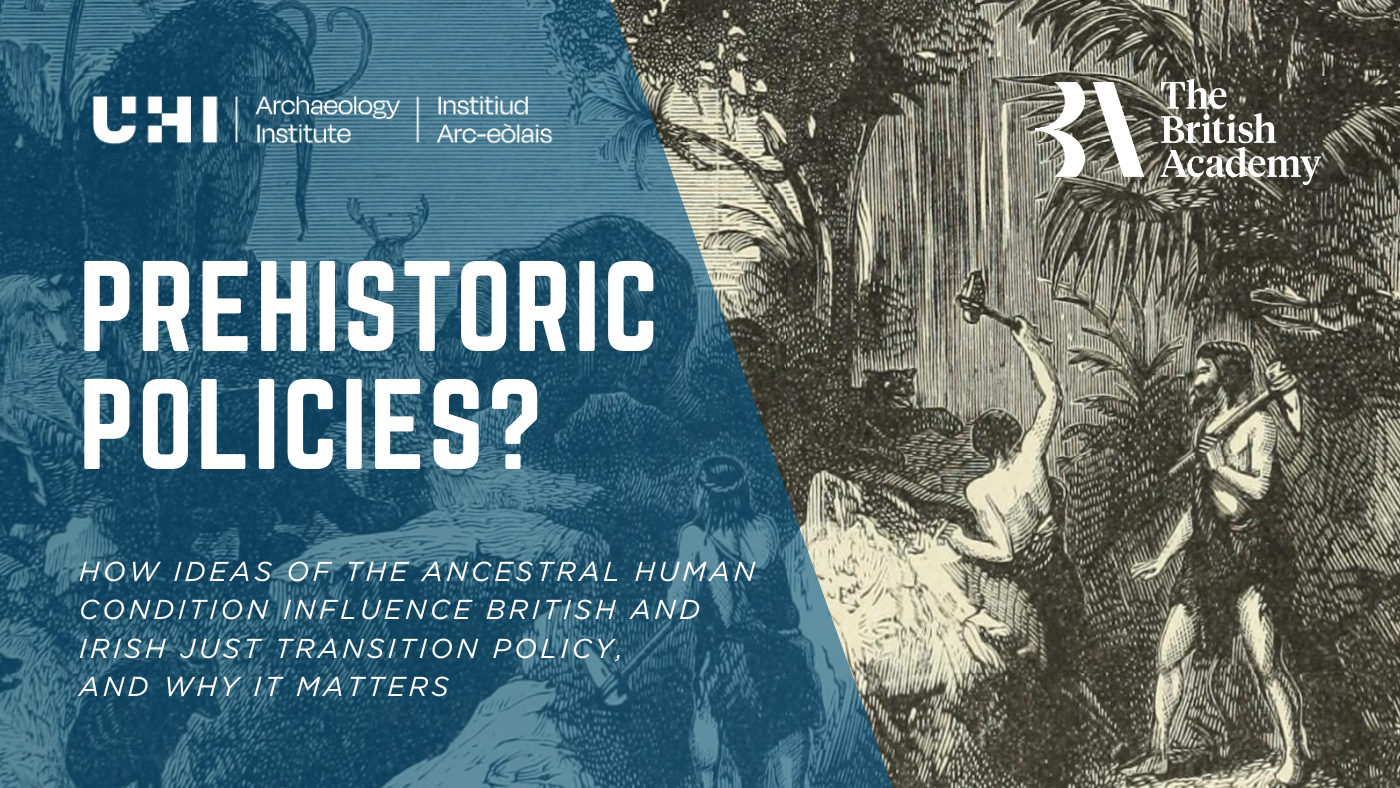
Prehistoric Policies addresses the concept of Ancestral Humanity – the idea that there is a “natural” state of human behaviour that evolved over thousands of years. It examines the impact of Ancestral Humanity on Just Transition policy in Britain and Ireland.
The project explores long-term approaches to human history that draw from both archaeological and anthropological evidence. This encompasses ideas around evolution and human nature, technological changes over the longue durée, our species’ relationship with its ecological niche. and long-term patterns in human ecology, behaviour and psychology.
Through analysis of public and private policy documents, the research papers cited within these documents, and interviews with policy makers themselves, we will track the understandings of the distant past from individuals within the policy making process back to their original authors. By doing this, we will gain a better understanding of how Ancestral Humanity is being used within Just Transition policy. We will also learn where these ideas come from and the role that popular science writing plays in translating academic research into policy. This knowledge will help us to create guidelines for policy makers wanting to work more critically with “deep past thinking” and direct them to cutting edge expertise and research within this field.
Prehistoric Policies is a 24-month project funded by the British Academy’s International Knowledge Frontier scheme. It involves archaeologists and anthropologists from UHI, SOAS and UCD.
Project Details
Project Details
Prehistoric Policies aims to trace an intellectual genealogy of the ancestral human within Just Transition policy and to understand the role and implications of this figure within the development of policy. By ancestral human we mean the recurrent practice of referring back to deep-time, or evolutionary time, to make claims about contemporary or future behaviour: with the ancestral human being used to show how humans in the present and future should behave.
The ancestral human condition is increasingly mobilised in both public and academic writing on subjects relevant to various environmental crises (Hobart & Maroney 2019, Lavi, Rudge & Warren 2024, Weedon & Patchin 2022). Each of these crises is seen to pose a fundamental challenge to humanity’s evolved biological, social and behavioural capacities. Yet these arguments, and the strategies they advocate for within a Just Transition, often make directly contradictory knowledge claims, and rest on evidence which is fiercely refuted within their source disciplines. This is facilitated by an ad hoc amalgamation of the deep past within the public (and wider academic) imagination. This conceptual “black-box” (Latour 1999) contains a powerful but poorly defined synthesis of concepts including ancestors, prehistory, hunter-gatherers, Neanderthals, the Palaeolithic, and the Stone Age (Pitcher 2022). This reference to the ancestral human leads to, at best, inaccurate, and, at worst, regressive and deceitful imaginations of what it might be possible to achieve in the face of environmental and social change.
Prehistoric Policies’ focus is trained on the literature currently enacting the Just Transition in Britain and Ireland. Our preliminary research has found three distinct strands of Just Transition policy that are intellectually underpinned by the concept of the ancestral human:
- Our essential and collective human instincts at the species scale.
- The capacity of our planet to support human life.
- The collective human perception of nature.
These strands have been identified in policy literature including the Stockholm 50+ background papers (Guisti et al. 2022), the Dasgupta (2021) Review and reports produced by the UK’s Parliamentary Office of Science and Technology (Grubb and Wentworth 2023), and as such are directly intertwined with government enactment of the Just Transition in Britain and Ireland. Prehistoric Policies will look beyond these preliminary findings and, through a comprehensive survey of relevant policy and adjacent literature, seeks to examine multiple aspects of Just Transition policy to identify influences of claimed ancestral humanity. As such, it is applied research that will take a conceptual approach developed across the humanities and social sciences, and use this to examine present-day Just Transition policy.
The project also aims to strengthen the political position of existing and future Just Transition policy. It has been carefully designed to heed Abrams et al’s (2020) call for an increase in transparency around policy formation as a means to foster public buy-in and mitigate societal backlash to what might otherwise be deemed to be economically challenging choices. It will do so through a programme of public events and panels, planned collaboratively with educational bodies whose focus includes the promotion of scientific understandings of ancestral humanity.
One might assume the Just Transition to be forward thinking – focused on how the future might be imagined and planned for in service of justice for all. It is perhaps surprising, then, that much of the Just Transition governmental and think-tank literature in Ireland and the UK is underpinned by research that makes explicit turns towards humanity’s deep past. It appears that as policymakers plan for a Just Transition, to theorise and contextualise the societal changes that are required, they often operationalise the figure of the prehistoric, ‘ancestral’ human. This involves alternately evoking a time before everything went wrong, or a fundamental human potential being suppressed by the complex problems of modernity. Often this happens obliquely, through the academic research or popular science literature referenced in policy and briefings.
As Geroulanos (2024) and others have highlighted, this turn to prehistory is longstanding and problematic. Recent critiques have highlighted the role that popular science and the transdisciplinary borrowing of data and theory have played in the propagation of empirically unfounded understandings of ancestral humanity within public and academic spaces (Pitcher 2022, Elliott et al. forthcoming). With deep-time, ancestral perspectives on 21st century challenges now being lauded by the likes of Bill Gates, Mark Zuckerberg and Barack Obama, their influence on the Just Transition forms a case study of how contentious ideas can filter, uncontested, into policy. Whilst this specific issue is in urgent need of redress in the context of Just Transition policy, it also holds broader lessons for policymakers on the strategic importance of disciplinary expertise in policymaking.
Prehistoric Policies asks:
- How and why does the ancestral human appear in Just Transition policy?
- What do we miss when we look to deep time for inspiration on how to achieve a Just Transition?
- How might such transitions be more productively, openly – and truthfully – imagined and enacted?
Prehistoric Policies aims to trace an intellectual genealogy of the ancestral human within Just Transition policy, and will fulfil this aim by meeting the following objectives:
O1: Ascertain how and why the figure of the prehistoric ancestor appears in contemporary understandings of Just Transition
O2: Analyse the roles of models, databases, epistemologies and popular rhetoric in the intellectual construction of the ancestral human
O3: Characterise the relationship between academic research, and public understanding of the ancestral human in Just Transition policymaking
O4: Facilitate public debate around the ancestral human and its role in the Just Transition
O5: Produce recommendations for Just Transition policymakers on maintaining critical handles over academic research and contentious popular science which risks eroding public trust and triggering societal backlash.
References
- Abram, S. et al. 2020 Just Transition: Pathways to Socially Inclusive Decarbonisation. COP26 Universities Network Briefing
- Dasgupta, P. 2021. The Economics of Biodiversity: The Dasgupta Review: Abridged Version HM Treasury.
- Elliott, B et al. forthcoming How, when and whether we should use the category 'hunter-gatherer’. Accepted ms. Nature Human Behaviour
- Geroulanos, S. 2024. The Invention of Prehistory: Empire, violence, and our obsession with human origins. Liveright Publishing.
- Grub, H. and J. Wentworth. 2023. What Is a Just Transition for Environmental Targets? Parliamentary Office of Science and Technology.
- Giusti, M et al. (2022). Valuing nature as individuals and communities. Stockholm+50 Background Paper Series. Stockholm Environment Institute.
- Latour, B. 1999. Pandora’s Hope: Essays on the Reality of Science Studies. Harvard University Press.
- Lavi, N. et al. 2024. ‘Rewilding Our Inner Hunter-Gatherer: How an Idea about Our Ancestral Condition Is Recruited into Popular Debate in Britain and Ireland’. Current Anthropology 65(1), 72-99
- Pitcher, B 2022. Back to the Stone Age: Race and Prehistory in Contemporary Culture. McGill-Queen's University Press.
- Weedon, G., & Patchin, P. M. (2021). The Paleolithic imagination:Nature, science, and race in Anthropocene fitness cultures. Environment and Planning E: Nature and Space, 5(2), 719-739.
Events
Events
Upcoming Events
Activate archaeology for just futures: Nordic TAG 2026
06-10 May 2026 0900-1600 Linnaeus University, Kalmar
When Are We? Time in the Light of Contemporary World Crisis
11 & 12 May 2026 0900-1600 Future Humanities Institute || Institiúid na nDaonnachtaí Feasta O'Rahilly Building (ORB) 2.20, University College Cork
Past Events
The Future of Prehistory: Prehistoric Society Day School ‘25
05 April 2025 1250-1730 Society of Antiquaries, Burlington House, Piccadily, London, W1J 0BE
Theory in action: tag 2025 (heritage for global challenges)
17 December 2025 0930-1540 School of Arts and Creative Tech