Archaeological dig to uncover new clues about Perth’s medieval past
A major archaeological excavation will take place in Perth next month as researchers seek to uncover new evidence about one of medieval Scotland’s most important religious sites.

The Perth Charterhouse Project, led by the UHI Centre for History, will investigate the grounds of the King James VI Hospital, on part of the site where the Perth Charterhouse is believed to have stood.
Founded by King James I and Queen Joan Beaufort in 1429, the Perth Charterhouse was the last monastery established by royalty in medieval Scotland and the only Carthusian foundation in the Scottish kingdom. It later became the final resting place of James I, following his assassination in Perth in 1437, and his queen following her death in 1445.
The Carthusian monastery operated for more than 130 years before it was attacked and dismantled during the Scottish Reformation. Much of its stone was subsequently removed and, today, little remains visible above ground.
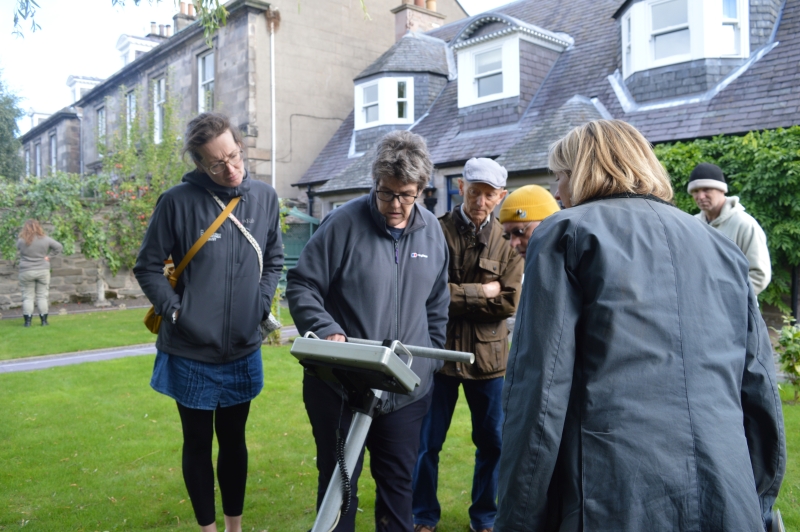
Sue Ovenden (AOC Archaeology Group) talking to visitors about scanning, King's Street. Photo courtesy of the Society of Antiquaries of Scotland.
Researchers now believe they have identified the likely location of the monastery’s outer precinct, following the most extensive ground penetrating radar survey of its kind carried out in Scotland.
The excavation, which begins on Monday 14 September, will focus on the area where ordinary people from Perth would have interacted with the Carthusian community.
Richard Oram, co-investigator on the Perth Charterhouse Project, said the team is particularly interested in what archaeological remains can reveal about everyday life in medieval Perth.
“We are not expecting to find King James I or royal treasure. Instead, we hope to uncover the everyday objects that people discarded, such as fragments of pottery, glass and other items.
“These seemingly ordinary objects can tell us a great deal about how people lived and about the relationship between the monastery and the wider community.”
The Perth Charterhouse Project has been a decade in the making and has involved local collaborators throughout its development, including the Perth and Kinross Archive and the residents living on the site. Volunteers from the Charterhouse neighbourhood have been invited to assist with the excavations and UHI History and Archaeology students will also have opportunities to develop heritage interpretation skills.
The dig cannot accommodate volunteers from outwith the immediate community due to the limited size of the excavation, but the wider public will have the opportunity to see the archaeology first-hand during two open days on Friday 18 and Saturday 19 September, from 10am to 4pm.
The open days will include walking tours, talks about the excavation and family-friendly activities. An information station will also be located beside the Carthusian Monastery Monument at the corner of King Street and Hospital Street, providing updates on the discoveries being made.
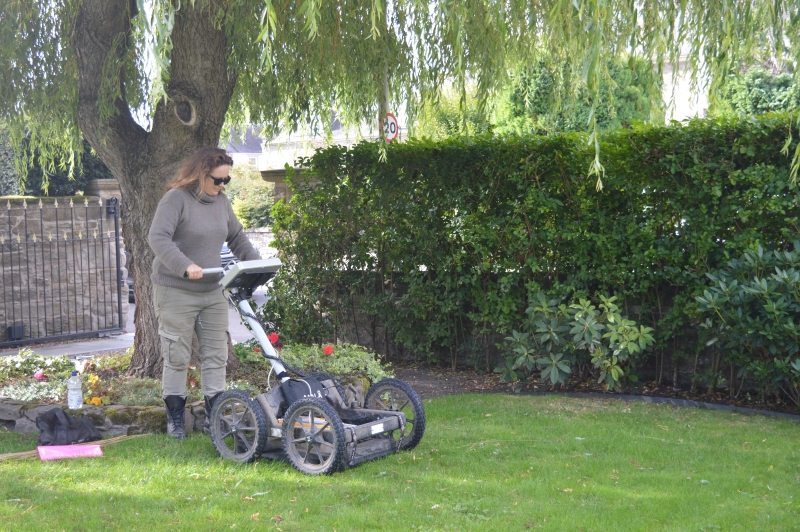
AOC Archaeology Group undertaking GPR scanning work, King's Street. Photo courtesy of the Society of Antiquaries of Scotland.
Dr Lucy Dean, from the UHI Centre for History, said the project offered a rare opportunity to connect people in modern-day Perth with the city’s medieval past.
“This is a huge part of Perth’s story. For this research to be taking place in the heart of the city, where people can see the archaeology for themselves, is very special.
“We are delighted that local people have been involved in the project and that the wider community will have the opportunity to come along, find out more and see the excavation taking place.”
The Perth Charterhouse Project is led by the UHI Centre for History, in partnership with the University of Stirling and the Perthshire Society of Natural Sciences (PSNS), working with Dr Gavin Lindsay (All Ages Ltd.) and AOC Archaeology Group. The excavation is being funded by two local organisations: the King James VI Hospital Trust and the Guildry Incorporation of Perth.