Medieval Religious & Legal Connections across the Norse Atlantic World. FSRS Online Symposium
The Faroese Shetland Research Symposia are the result of discussions between colleagues from the INS UHI Shetland, and the Fróðskaparsetur Føroya. Shetland and the Faroe Islands might speak different languages today, but they share history, cultural heritage and geographical proximity.
[ When
to
o Where
Remote Access Only
-
8 Remote access
Register now for link to event.
£ Cost
Free
É Contact
Dr Andrew Jennings
email:
ins@uhi.ac.uk
tel: 01856 569300
à Add to Calendar
q Share
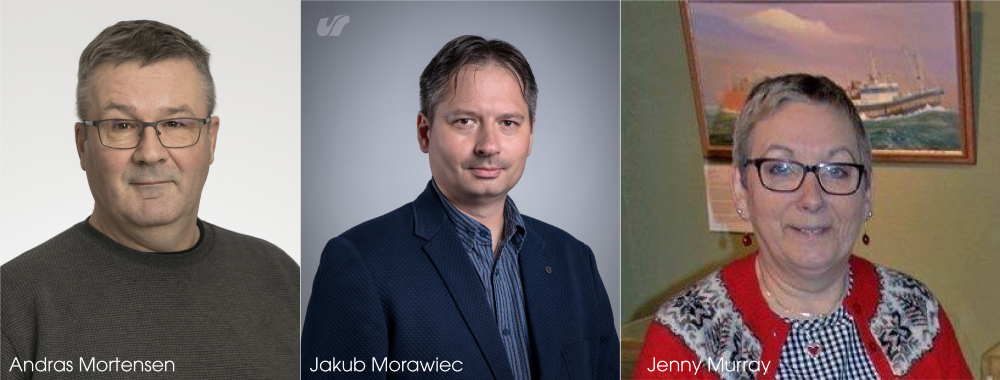
This FSRS symposium will discuss the work of three researchers: Jenny Murray, Curator of Collections (Archaeology) at Shetland Museum and Archives, Dr Andras Mortensen, Associate Professor of History at the Fróðskaparsetur Føroya, and Dr Jakub Morawiec, Associate Professor and Head of the Centre for Nordic and Old English Studies at the Institute for History, University of Silesia in Katowice, Poland.
The programme for the afternoon includes presentations on the following:
From Kirkwall to Kirkjubøur, a discussion of the material legacy of St Magnus, a truly island saint by Jenny Murray
- Jenny is a Shetlander with a lifelong passion for the Islands' history and culture, studying various aspects of Shetland's archaeology collection and church history. She is Curator of Collections (Archaeology) at Shetland Museum and Archives and has recently submitted her PhD thesis looking at the surviving material legacy of the Cult of St Magnus in the North Atlantic.
Widening the Gulathing jurisdiction to Shetland and Faroes by Andras Mortensen
- Andras Mortensen is Associate Professor of History at the Fróðskaparsetur Føroya . He wrote his PhD on Faroese boat-building tradition at in 2001. From 1989 he was a curator and later, from 2006, Director of the National Museum of the Faroes and Keeper of National Antiquities. From 2011 he has also been a director of Søvn Landsins, Faroese Cultural Heritage. He joined his current position at the university in 2017. In 2023 he published the Kongsbókin (AM 33 4to), which was the law book of the lawman of the Faroes from c. 1300 to 1604.
Rognvaldr Kali Kolsson's pilgrimage to the Holy Land and contemporary European politics by Jakub Morawiec
- The journey to the Holy Land is without doubt a highlight of the Orcadian jarl Rǫgnvaldr Kali Kolsson’s life and probably the most outstanding achievement of his reign. He was accompanied by prominent individuals like Orcadian bishop Vilhjálmr and Norwegian jarl Erling skakki. Their route led along the shores of Scotland and England, France (Valland) and Galicia in Spain, Mediterranean, North Africa (Serkland) and Crete (Krít). In summer 1152 they landed in Acre (Akrsborg). They spent several weeks in the Holy Land and, then, several in Constantinople where they were welcomed by the emperor Manuel (konungr Menelías).Their return route led through Durazzo (Dyrakksborg) to Puglia (Púl) in Italy, where they left their ships there and continued their journey on horses. First they rode to Rome then all the way to Denmark. From there they crossed to Norway. They returned to Orkney by Christmas 1153.
- Rǫgnvaldr's expedition took place during a period of unstable European politics. Continental elites were still dealing with post-2nd Crusade trauma and a big military encounter between Byzantium, Germany and Sicily was just about to erupt. The aim of my talk will be to show jarl's expedition in context of current Continental politics, and wonder to what extend Byzantine-Sicilian controversy, engaging both the Papacy and the Empire, could have influenced Rǫgnvaldr's endevarours, especially both timing and route of the return to North.
- Jakub Morawiec is associate professor and Head of the Centre for Nordic & Old English Studies at the Institute of History, University of Silesia in Katowice, Poland. His research concentrates on history of the Viking Age and medieval Scandinavia, Icelandic skalds and their poetry, ideology of royal power, Scandinavina-Slavonic relations in the medieval period. He is the co-organizer of the Jómsborg Conference series, author of numerous monographs and articles published in Poland and abroad, and is also known as for translating several Icelandic sagas into Polish.
The symposium is online. Everyone is welcome to access the symposium by registering below. You will receive a link and a reminder 24 hours before the event.
Privacy
Please read our policy on how we treat any personal information collected in relation to our events:
Data Protection Statement for Events